


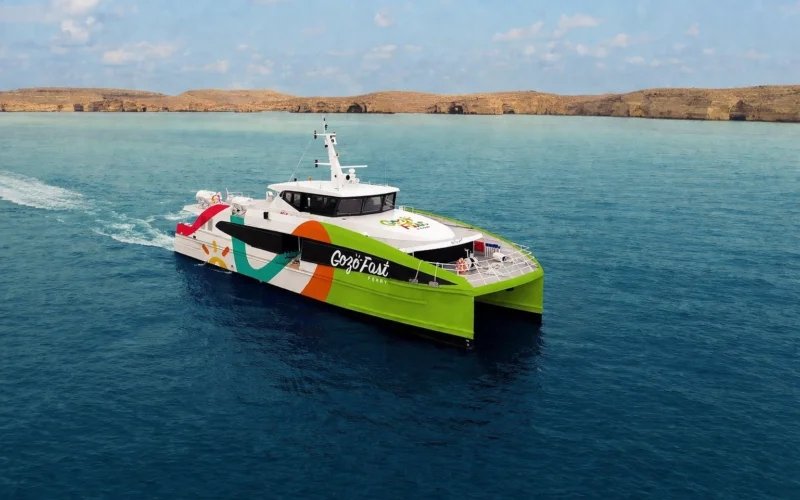
Malta’s transport network has received a timely upgrade just ahead of the summer rush. As of 5 May, a new fast ferry route now connects Gozo, Buġibba and Sliema, adding a practical alternative to the usual Ċirkewwa route and complementing the Valletta fast ferry.
For residents, expats and regular commuters, this is not just a new line on the map. It represents a shift toward more flexible and time-efficient travel across the islands, particularly during months when traffic and ferry queues tend to become part of daily life.
What the New Route Offers
The service connects Mgarr in Gozo with Buġibba and Sliema in a single, continuous route. Each leg takes approximately 25 to 30 minutes, offering a realistic alternative to driving across Malta and relying on the traditional Gozo Channel ferry.
A key feature of the route is the scheduled 15-minute stop in Buġibba. Rather than simply passing through, the service is structured to allow smooth boarding and disembarkation, effectively positioning Buġibba as a functional connection point for the north of the island.
This changes how journeys can be planned. Travellers from Sliema no longer need to cross Malta to reach Gozo, while those based in the north gain direct access without detouring through Valletta. The route fits more naturally around where people live and move on a daily basis.
The timetable supports this approach. Departures are spaced consistently throughout the day, from early morning through to evening, making the service suitable for both commuting and flexible travel. The inclusion of Buġibba in every crossing is built into the schedule, maintaining a steady flow without adding unnecessary delays.
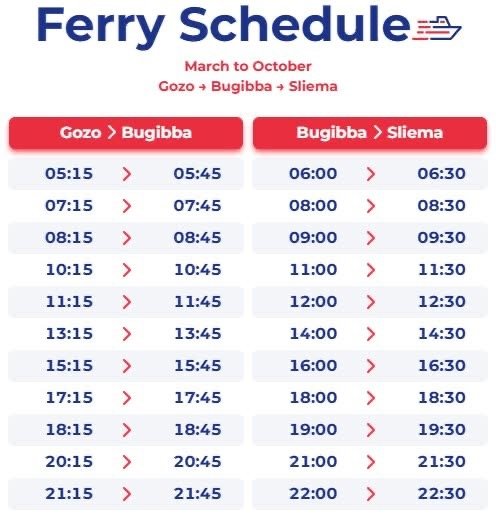
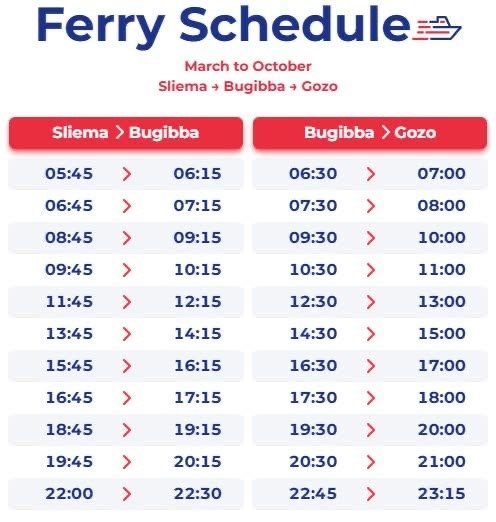
Gozo Buġibba Sliema ferry schedule with departure times from Mgarr, Buġibba and Sliema for summer service
Ticket prices, concessions and how to book
The fare structure for the new route is clear and competitive, with pricing that reflects both the speed of the service and the need to keep it accessible for regular users. Fares vary depending on the route and eligibility, with reduced rates in place for Gozo residents and specific passenger categories.
Bellow is the full fare breakdown for Gozo to Sliema fast ferry route including standard tickets, Gozo resident discounts, concessions and free travel categories
| Kategorie | Fare (€) | Anmerkungen |
|---|---|---|
| Standard (Adults & Youths) | €8.50 | One-way fare |
| Gozo Residents | €2.25 | Gozitan ID or residence permit required |
| Studenten | €4.50 | University of Malta & MCAST only |
| Tallinja Card Holders | €6.50 | Upon presentation of Tallinja card |
| Senior Citizens | €3.00 | ID card required |
| Passengers with Special Needs | €3.00 | Blue or yellow card required |
| Children (4–10 years) | €4.00 | Standard fare |
| Children (4–10, Tallinja) | €3.00 | With Tallinja card |
| Infants (up to 3 years) | Kostenlos | All fares |
| Hospital Appointments | Kostenlos | Proof of appointment required |

While the table reflects the full fare for journeys between Gozo and Sliema, the route itself is structured in segments, which means passengers are not limited to end-to-end travel. Shorter crossings, particularly between Buġibba and Gozo, are priced lower, and the Sliema to Buġibba leg remains free for Tallinja card holders. This creates a more flexible pricing model, allowing passengers to choose routes based on both convenience and cost.
In practice, the service operates as a connected system rather than a single journey. Travellers can select their departure and arrival points depending on where they are based, whether that is Sliema, Buġibba or Gozo.
Tickets can be purchased online through the Gozo Highspeed booking platform or directly at the terminal before departure. The online system allows passengers to select routes, times and applicable fare categories in advance, and also helps operators manage capacity across each stop. This is particularly relevant given the structured nature of the route, where passenger flow between Sliema, Buġibba and Gozo is actively monitored.
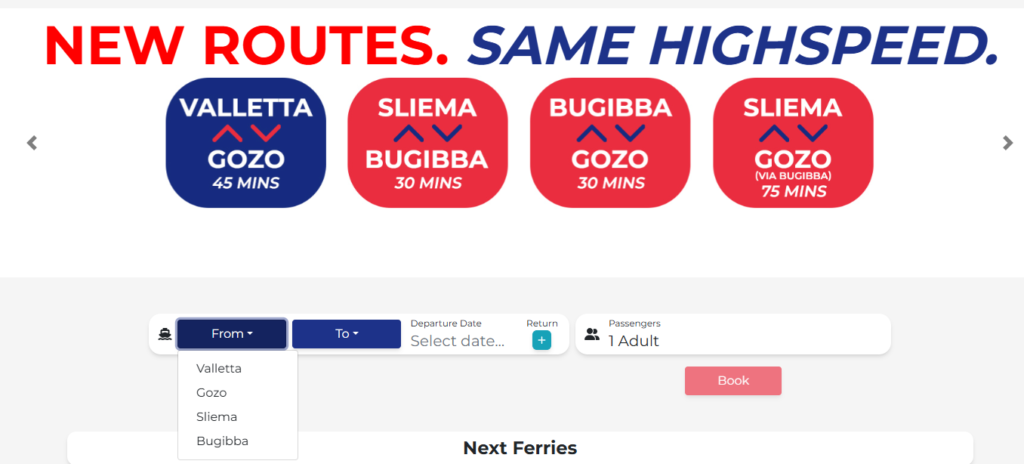
Online bookings typically close 30 minutes before departure. For those travelling at short notice, tickets may still be available in person, although availability will depend on demand, especially during the summer season.
Why this route is genuinely efficient
Efficiency here is not just about speed. It is about reducing friction in the overall journey.
First, the route removes the need to travel to Ċirkewwa for many passengers. For anyone living in central or northern Malta, this alone can save a significant amount of time. Second, it distributes passenger flow more evenly across the island. Instead of funneling everyone through a single departure point, it creates multiple access points. Third, it aligns better with where people actually live and work. Sliema and Buġibba are both high-density areas for residents, expats and businesses. Connecting them directly to Gozo makes practical sense.
How it compares to the Valletta fast ferry
The Valletta to Gozo fast ferry remains a central part of Malta’s maritime transport network, offering a direct connection with a journey time of around 45 minutes. Standard fares typically range from €7.50 one-way to approximately €13 return, while Gozo residents benefit from reduced rates, generally around €2.50 per trip.
The introduction of the new route does not replace the Valletta service. It broadens the network.
The Valletta connection continues to serve those working in or around the capital, particularly for structured, office-based routines. In contrast, the Gozo, Buġibba and Sliema route is better aligned with residential and commercial areas along the coast, where a large share of Malta’s population and expat community is based.
What this effectively creates is a more flexible system. Instead of depending on a single departure point, passengers can now choose routes based on proximity, timing and purpose of travel. For some, Valletta will remain the most direct option. For others, avoiding cross-island travel altogether will make the new route the more practical choice.
A practical shift in how Malta moves
This new ferry connection is part of a wider shift toward improving mobility between Malta and Gozo without adding further pressure on the road network. For expats, business owners and residents, it introduces a more practical way to plan travel, with greater flexibility and less reliance on a single route. For Gozo, it enhances accessibility, while also bringing into focus the need to manage increasing demand, particularly during peak months.
In a country where timing often depends on traffic, having more than one reliable option can make a noticeable difference.




 English
  Danish
  French
  German