


We spend a lot of our time at Expatax telling people that a tax headline is rarely the whole story. This one is a good example.
From 1 January 2027, Malta is folding its four special tax programmes into one, called the Individual Tax Programme. The 15% rate on foreign income you bring into Malta stays. The government has been careful to say so, and it is true.
What they say less loudly is that the minimum tax for most applicants goes from €15,000 a year to €35,000 a year, the property you need to buy goes from €220,000 or €275,000 to €700,000, and the application fee goes up too.
There is a way to avoid all of that for five years. Get your application in by 31 December 2026 and you stay on the current rules until 31 December 2031.
Depending on your income, that is somewhere between nothing and about €100,000 in your pocket.
The four programmes today and the four statuses from 2027
Right now Malta runs the Global Residence Programme for non-EU nationals, The Residence Programme for EU, EEA and Swiss nationals, the Malta-Ruhestandsprogramm, und die United Nations Pensions Programme.
Legal Notice 195 of 2026 replaces them for new applicants from 1 January 2027 with four statuses under the Individual Tax Programme: Global Resident, EU/EEA/Swiss Resident, Retired Pensioner and UN Pensioner.
The mapping is one to one. The conditions are not.
The 15% rate is not the number that matters
Everyone fixates on the 15%. Under both the old and the new rules, qualifying foreign income received in Malta is taxed at 15%, and Malta-source income at 35%. Nothing changes there.
What changes is the minimum you pay regardless of what 15% of your income comes to. Today that floor is €15,000. From 2027 it is €35,000 for Global Resident und EU/EEA/Swiss Resident status. A floor of €15,000 bites until your qualifying income reaches €100,000. A floor of €35,000 bites until it reaches about €233,333.
That is the whole reform in one sentence. Everything below is what it costs you.
Pay only what you owe
Need help understanding the Malta tax system? From Malta tax returns and expat tax advice to corporate compliance and business accounting services in Malta, we help individuals and companies stay compliant and tax-efficient.
Get tax advice →What the difference is worth, in euros
This table is the reason to read the article. It is not exciting to look at. It is quite exciting to be on the right side of.
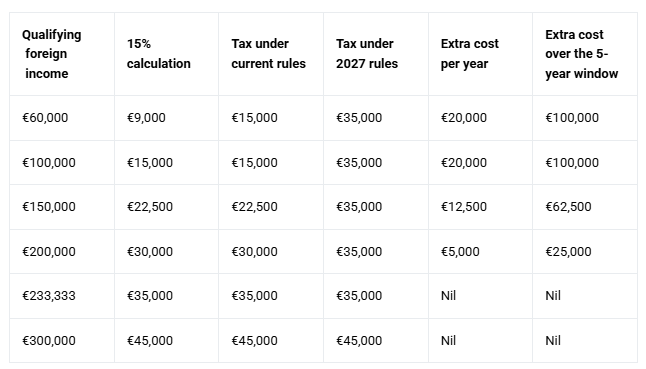
Read the last column. If you bring €100,000 a year into Malta, applying in 2026 rather than 2027 is worth €100,000 to you over the transitional period. Not a rounding error.
If you bring in €150,000, it is €62,500. Still a decent car.
If you bring in more than about €233,333, the reform costs you nothing, because your 15% already clears the new floor. You are paying a big tax bill on a big income, which is a good problem to have.
Simplified, of course. Double tax relief, dependants, Malta-source income and the nature of each income stream all move the numbers. That is precisely why we run this on your actual figures rather than a table.
Who the €35,000 floor applies to
Not everyone, and it would be misleading to suggest otherwise.
| Status from 2027 | Minimum annual tax |
| Global Resident Status | €35,000 |
| EU, EEA and Swiss Resident Status | €35,000 |
| Retired Pensioner Status | €15,000 |
| UN Pensioner Status | €20,000 |
Retirees do not escape. The current Retirement Programme floor is €7,500 plus €500 per dependant. It doubles to €15,000. That is €7,500 a year, or €37,500 over five years, for a retired couple with no dependants.
The UN Pensioner floor of €20,000 applies to income other than the UN pension itself, which stays exempt when received in Malta.
Property: the bigger decision for buyers
The tax is annual. The property is capital, and here the change is brutal for anyone planning to buy.
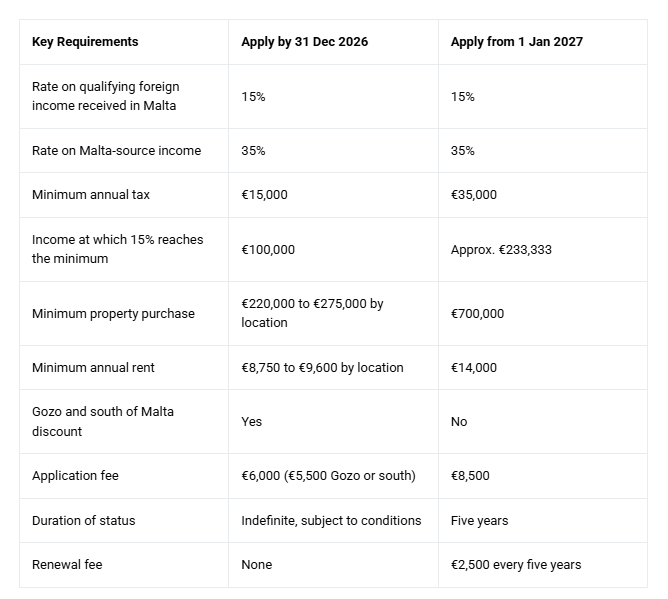
Today you qualify by buying at €275,000 in most of Malta or €220,000 in Gozo and the south, or by renting at €9,600 or €8,750 a year. From 2027 there is one national threshold: buy at €700,000 or rent at €14,000 a year. The Gozo and south of Malta discounts disappear.
For renters, that is €4,400 to €5,250 a year more in minimum rent. Annoying, not decisive. For buyers, it means tying up an extra €425,000 to €480,000 in Maltese property just to satisfy the condition. A €300,000 apartment in Marsascala qualifies today. In 2027 it does not, however nice the sea view.
There is a line in the rules saying property already held below the new threshold may continue to qualify at the Commissioner’s discretion, under guidelines not yet published. We have seen enough Maltese guidelines to advise against building a plan on that.
Fees and duration, because these add up too
The current Global Residence Programme fee is €6,000, or €5,500 for property in Gozo or the south. The new fee is €8,500.
Under the current programmes your status runs indefinitely as long as you keep meeting the conditions. From 2027 it runs for five years, renewable at €2,500 a time. Malta has discovered the subscription model.
Everything side by side
The fine print
A few things that do not make the headlines but will make a difference to your bill.
Submitted, not approved. The transitional rule protects applications submitted by 31 December 2026. Approval in 2027 is fine.
Full year, no refunds. Under the new rules the minimum tax is due in full for the year status is granted and the year it ceases – it is not refundable. Timing your start and your exit matters.
2031 is not forever. Grandfathered beneficiaries move onto the new programme after 31 December 2031 and must meet its conditions then, including the €700,000 property test. Plan for that now, not in 2031.
Remittance, not worldwide. Only foreign income you receive in Malta is taxed at 15%. Foreign income left abroad is not taxed. Foreign capital gains are not taxed even if you bring them in. How you structure what comes into Malta is often worth more than which programme you are on.
Special tax status is not tax residence. Getting the status does not make you resident. Residence is tested separately, and some people are better off as ordinary resident non-domiciled taxpayers with no programme at all, no minimum tax and no property test.
Immigration is separate again. The tax programme gives you a tax status, not a right to live in Malta. You need both.
Should everyone apply before the end of 2026?
No. And we would rather lose a fee than have you pay €15,000 a year for a status you did not need.
The people who should move quickly are those whose 15% calculation lands below €35,000, and those who were planning to buy at less than €700,000. For them the transitional window is worth real money.
The people who can relax are those remitting well above €233,333 and those already buying at €1 million in Sliema. The reform barely touches them. Congratulations on the income.
Everyone in between needs the numbers run properly: nationality, current residence, where each income stream arises, where it will be received, pensions, dividends, company ownership, capital gains, treaty relief. That is the work.
The bottom line
Malta’s 15% rate is not going anywhere. The cost of getting it is.
Apply by 31 December 2026 and you keep the €15,000 floor, the lower property thresholds and the lower fee until the end of 2031. For someone bringing €100,000 a year into Malta that is worth around €100,000 over the window. For someone bringing in €250,000 it is worth nothing.
Which of those you are is a question of arithmetic, and the arithmetic is what we do.
Check your situation on time
We work closely with our trusted partners to help you get a clear picture of your position before you become resident: which programme, if any, may suit your circumstances, how your income and gains could be treated once you are here, and whether applying in 2026 could make financial sense. Getting the right professional guidance before establishing residence can help avoid costly surprises later.
Pay only what you owe
Need help understanding the Malta tax system? From Malta tax returns and expat tax advice to corporate compliance and business accounting services in Malta, we help individuals and companies stay compliant and tax-efficient.
Get tax advice →This article is intended for general information only and does not constitute tax, legal or immigration advice. Tax treatment depends on individual circumstances and the applicable legislation. Professional advice should be obtained before taking action.





 English
  Danish
  French
  German