


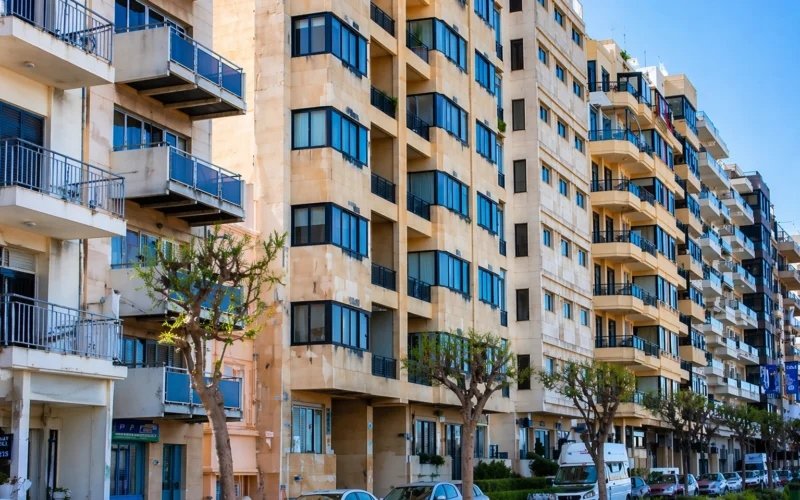
Standfirst: Expatax Malta’s 2026 rent and yield update on apartments in Malta, compiled with our data scientist Eliseo Kolicaj, captures Malta’s rental market as it looks now, not as a backward-looking annual average. Built from 17,649 live advertised rental observations, it shows the familiar trade-off in sharper detail: prime coastal postcodes still command the highest apartment rents, but they still do not produce the strongest gross yields.
Malta’s rental market in 2026 has strengthened where you would expect, but not always in the way investors might hope.
Prime coastal rents have moved higher again. Gross yields have not. That is the clearest year-on-year takeaway from this latest dataset, which captures the market as it currently looks through 17,649 live advertised rental observations, including 16,309 apartment listings and 1,340 house listings.
This is more than just a look in the rearview mirror. By analyzing thousands of live data points, we’ve captured the market in motion—revealing exactly where rents have surged, where they’ve hit a ceiling, and where skyrocketing capital values are now suffocating returns.
In 2026, the Malta property trade-off is unavoidable: Prestige is a luxury that your spreadsheet might not forgive. For those tracking the long-term trend, this snapshot can be compared directly to our previous Malta rental prices update to see exactly how the market has shifted over the last 12 months.
Coastal rents strengthened, but yields still lagged
The 2026 data points to a market still under pressure from the same structural forces, but not moving evenly across every region or property type.
The clearest shift is in the coastal core. Average apartment asking rents have strengthened to €1.6K a month, moving above the roughly €1.4K to €1.5K range seen in early 2025.
Gozo, meanwhile, has not stood still. Apartment asking rents there rose by 11.5% year on year, the strongest regional increase in the dataset, even though it remains Malta’s cheapest apartment market overall.
There is also evidence of more targeted strength in specific bedroom bands. In the raw sheet, Central one-bed apartment rents rise by 7.5% to €1,075. North one-beds increase by 10% to €1.1K. In the prime coastal belt, two-bed apartment rents climb by 7.1% to €1.5K. South Malta’s two-beds remain flat at €1.2K, which is one reason the region still stands out as a more yield-friendly market.
Jobs, tourism and supply kept rents firm
Malta rental prices in 2026 are not doing anything especially mysterious. They are doing what strong job growth, heavy tourism and expensive coastal property usually make them do.
Official labour data shows total employment reached over 330K in late 2025, up 2.9% year on year, adding more tenants to Malta’s main job centres and commuter belts.
Tourism continues to add another layer of demand. Malta recorded over 3.5 million inbound tourists in 2024, and almost 85% of guest nights were spent in rented accommodation establishments. That does not explain every individual rent increase, but it does explain why landlords in Malta’s busiest rental zones still feel confident testing higher asking prices.
Supply is growing too, but not at a scale that has made prime areas feel cheap. Malta approved over 12K new dwellings in 2025, and 72.1% of them were apartments. So the pipeline is growing, but it is growing in a market where demand remains concentrated in familiar areas.
Prime postcodes still lead on rent
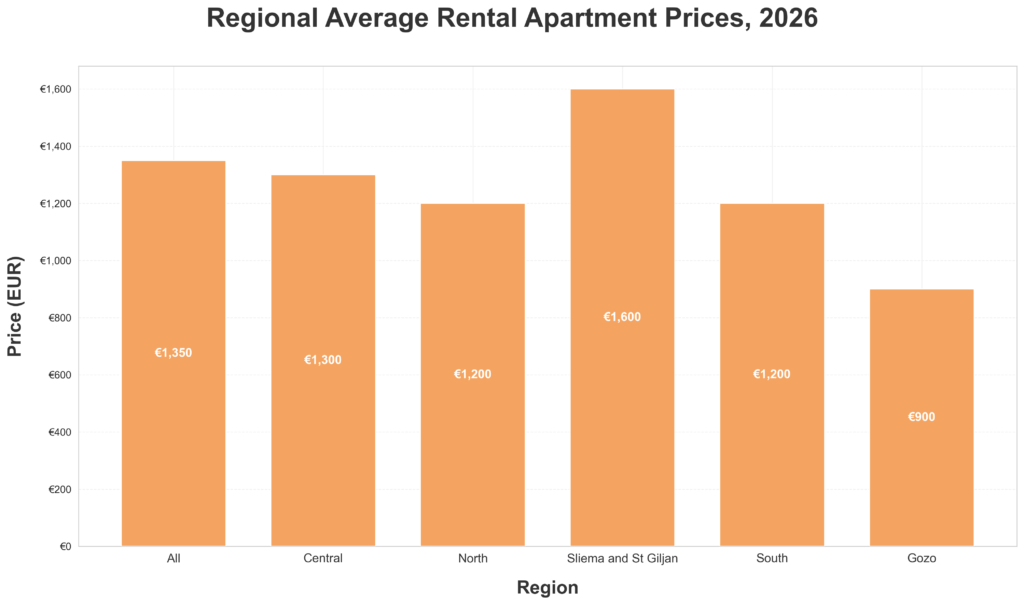
Across Malta, apartment asking rents average €1.35K a month in 2026.
- In the prime coastal belt, that rises to €1.6K.
- In Central Malta, it is €1.3K.
- In both North Malta and South Malta, it is €1.2K.
- In Gozo, it falls to €900.
That leaves the average apartment in Malta’s prestige coastal market asking almost €700 more a month than Gozo. Put more plainly, Gozo remains close to half the price of the island’s most expensive apartment zone.
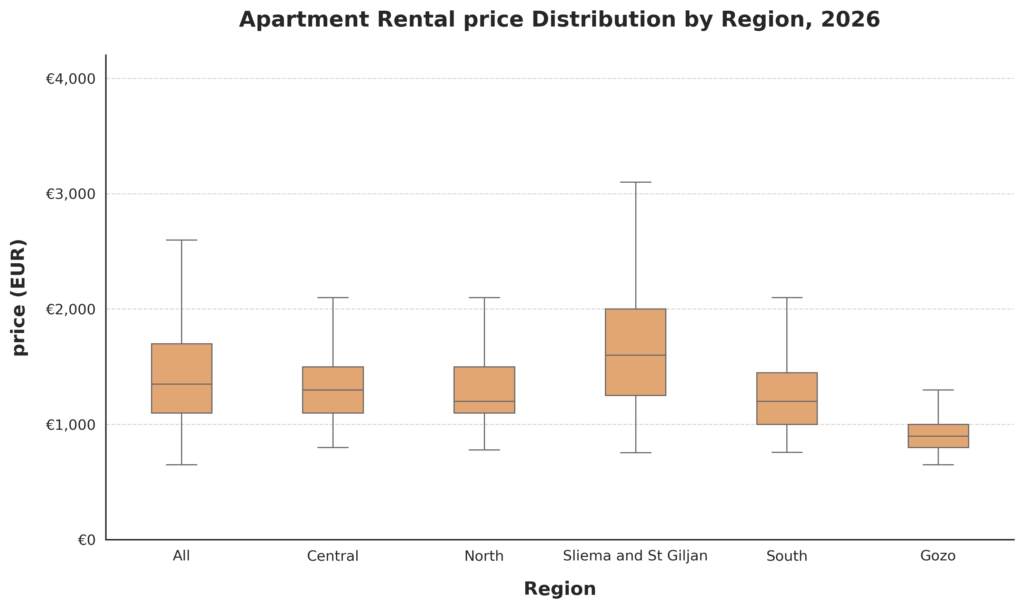
The bedroom-level data tells the same story in finer detail. In Sliema and St Julian’s, the median asking rent in 2026 comes in at roughly €1.5K for a two-bed, €1.85K for a three-bed and €2K for a four-bed. In Gozo, a typical two-bed sits at €875 and a three-bed at €900. The gap is not subtle.
Better yields still sit in Central and South
This is where the article starts to challenge the headline narrative. In Malta’s prime coastal market, apartment rents are the highest in the dataset. Gross yields are not.
At regional level, the picture is blunt. Central Malta averages 4.4%, South Malta 4.3%, Gozo 4.1%, North Malta 3.9%, and Malta overall 3.8%. The prime coastal belt comes in at just 2.6%.
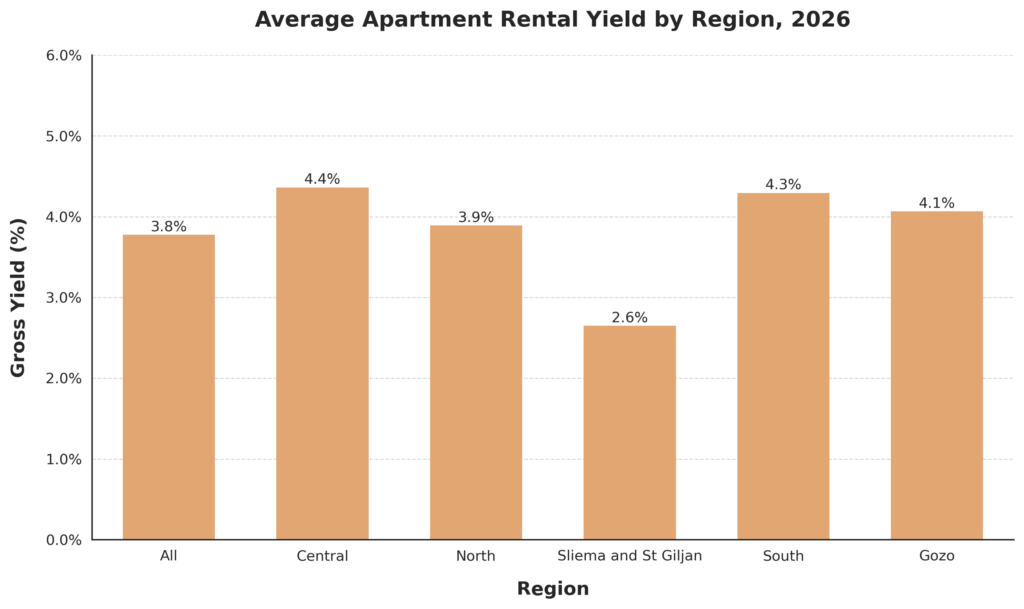
That is the classic Malta property trade-off. Prime locations command higher monthly rents, but they also command much higher capital values. Once purchase prices outrun rent growth, yields weaken. Or in plain English: the sea view is lovely, but it does not help the spreadsheet nearly as much as people like to think.
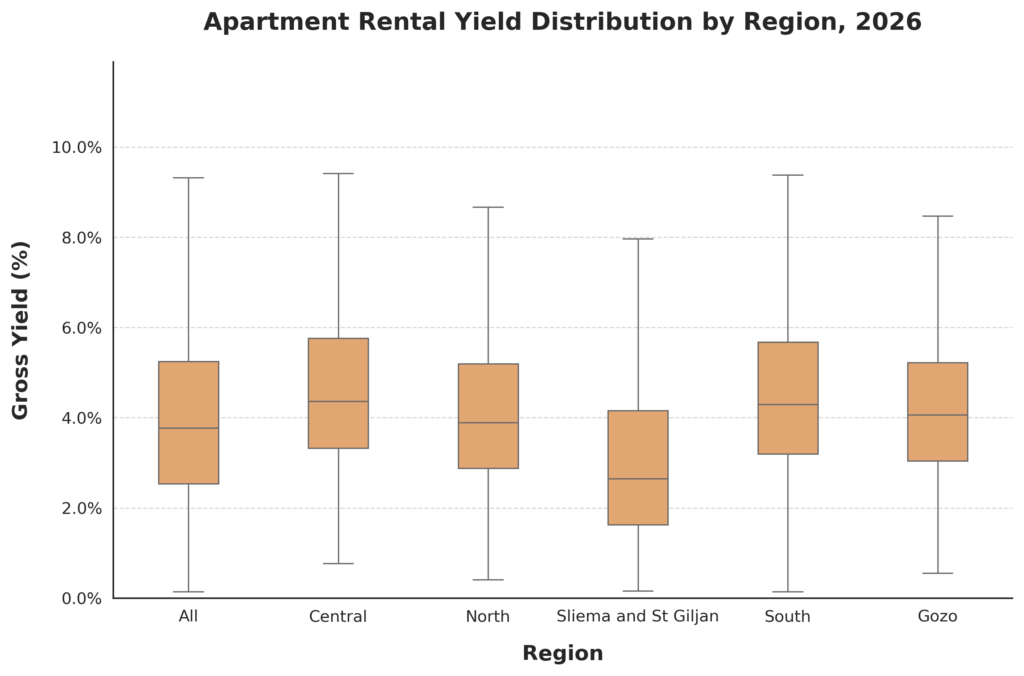
The distribution chart makes the point rather rudely. Central and South Malta show a healthier spread of high-performing yields, while the prestige coastal market sits lower and tighter. Prestige is real. Yield compression is real too.
Long-let yields are not the same as short-let returns
This article focuses on gross long-term rental yield, using advertised rents and asking sale prices. That makes it useful for comparing regions on a like-for-like basis. But readers should be careful not to confuse that with the economics of short-let property. In Malta, some highly touristic areas can look weaker on long-term yield while still appealing to owners targeting seasonal or short-stay demand. Equally, short-term rentals come with a very different cost base, occupancy risk profile and management burden.
That is why long-term and short-term rental performance should not be treated as the same story. Readers who want to go further on that can also see our article on short-term vs long-term rentals in Malta.
House data helps, but apartments tell the main story
The house-rent data is worth showing mainly because it reminds you how untidy that market can be. With 1,340 house listings in the dataset, the regional house picture is much thinner than the apartment one. A few large villas can move the numbers quickly, especially in the North and in the coastal prestige belt. That makes the house data useful, but more directional than definitive.
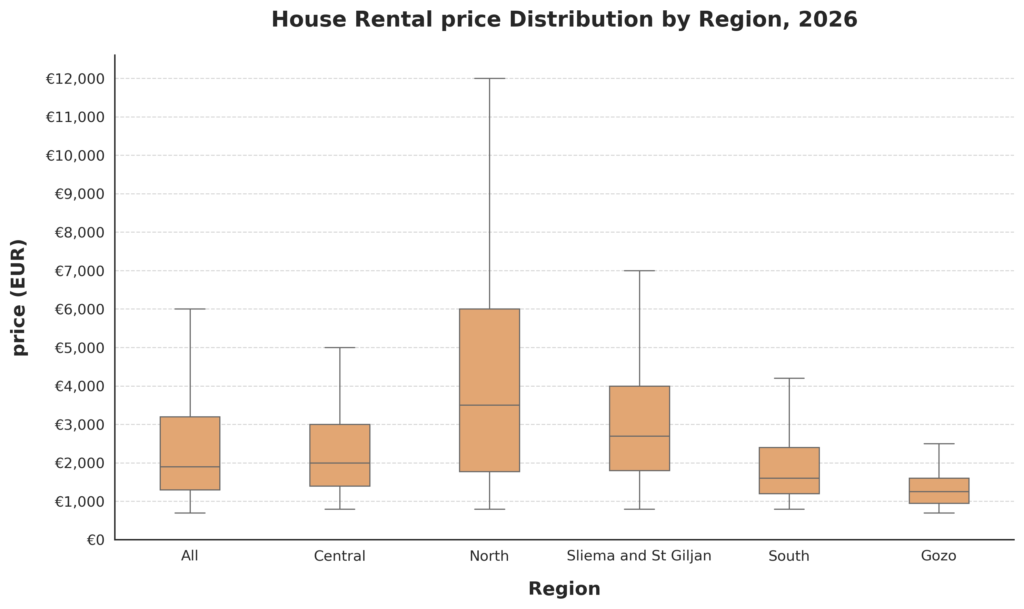
Houses also tend to sit closer to the lifestyle and luxury end of the market, which means pricing is more easily distorted by a small number of standout listings. The apartment dataset remains the stronger lens for understanding the broad rental market.
Buy for yield, rent for value, buy prime for prestige
Where to buy for yield: Central and South Malta.
That is where the buy-to-let maths still looks cleaner. Lower entry prices help. The rent-to-price ratio behaves better. It is not romantic. It is just arithmetic.
Where to rent for value: South Malta and Gozo.
If the brief is to spend less each month, that is where the relief sits. South averages €1.2K for apartments. Gozo sits at €900. The prime coastal belt averages €1.6K. That is a large gap in anyone’s monthly budget.
Where to invest defensively: Malta’s best-known coastal postcodes still suit buyers who care more about prestige, liquidity and long-term defensiveness than immediate cash flow. They remain strong lifestyle and status markets. They simply look less attractive for yield hunters.
For a broader view on how property prices are shifting alongside rents, see our Malta property prices 2026 update.
The 2026 cheat sheet
Malta’s rental market still looks supported by the same three forces. Jobs are up. Tourism is strong. New supply remains apartment-heavy. The prime coastal belt remains the most expensive place to rent an apartment. Gozo remains the cheapest, at about half the price. Central and South still offer the better gross-yield story. Which is another way of saying that in Malta property, the flashy postcode and the better investment case are still rarely living at the same address.
Click the arrow next to each question to expand the answer.
What are average apartment rental prices in Malta in 2026?
The average advertised apartment rent in Malta in 2026 is €1.35K a month. That figure comes from a live-market dataset of more than 16K apartment listings, so it reflects the market as it currently appears rather than a simple backward-looking annual average.
Where are the highest apartment rents in Malta in 2026?
The highest apartment asking rents in 2026 are in Sliema and St Julian’s, where the average sits at €1.6K a month. That keeps the prime coastal belt well above the national average and far ahead of lower-cost markets such as Gozo.
Where are the cheapest apartment rents in Malta in 2026?
Gozo remains the cheapest apartment market in the dataset, with average asking rents at €900 a month. That is a little under half the level seen in Malta’s prime coastal apartment market.
Which areas in Malta offer the best rental yields in 2026?
On a gross long-term rental yield basis, Central Malta and South Malta look strongest in the 2026 data. Central averages 4.4%, South 4.3%, and Gozo 4.1%, compared with 2.6% in the prime coastal belt.
Why are rental yields lower in prime Malta locations?
Because purchase prices are much higher in prestige locations. Higher rent helps, but when capital values rise faster than rental income, the rent-to-price ratio weakens and gross yield gets compressed.
Is Sliema still a good place to invest in Malta property?
That depends on the goal. If the priority is prestige, liquidity and long-term defensiveness, Sliema and nearby prime postcodes can still make sense. If the priority is stronger gross rental yield, the 2026 data suggests Central and South Malta often look more attractive.
Did Malta rental prices rise year on year in 2026?
Yes, but not evenly across the market. Some key apartment bands strengthened, while others stayed flat. In the data, Central one-bed rents rise by 7.5% to €1,075, North one-beds rise by 10% to €1.1K, and prime coastal two-beds increase by 7.1% to €1.5K. South two-beds stay flat at €1.2K.
Why have Malta rental prices stayed high in 2026?
The 2026 market still appears to be supported by three main forces: strong employment, heavy tourism and continued apartment-led demand. Official data shows over 330K people in employment in late 2025, over 3.5 million inbound tourists in 2024, and almost 85% of guest nights spent in rented accommodation establishments.
Is more housing supply coming onto the Malta market?
Yes. Malta approved over 12K new dwellings in 2025, and 72.1% of them were apartments. That means supply is growing, but demand remains concentrated enough that prime areas have not suddenly become cheap.
Is this Malta rental research based on asking prices or signed leases?
This research is based on asking rents and asking sale prices, not signed leases or net realised returns. That makes it a strong real-time snapshot of the market, but it should not be confused with final transaction data.
What does gross rental yield mean in this article?
Gross rental yield is a simple first-pass measure comparing annual rent to property price. It does not include vacancy, tax, maintenance, insurance, agency fees, repairs or fit-out costs. In other words, it is useful, but it is not the same thing as net investor return.
Does this article cover short-term rentals in Malta too?
Not directly. This article focuses on gross long-term rental yield. Short-let and holiday rental property can behave differently, especially in tourist-heavy locations, so those returns should be considered separately.
Where should tenants look for better rental value in Malta?
For renters focused on value rather than prestige, South Malta and Gozo remain the obvious places to look. In the 2026 data, apartment asking rents average €1.2K in the South and €900 in Gozo, compared with €1.6K in the prime coastal belt.
Where can tenants learn how to rent a property in Malta?
If you are approaching the market as a tenant rather than an investor, it makes sense to pair this market snapshot with a practical renting guide. Our how to rent a property in Malta article is the natural next read.
What to Do Next
If you are looking at Malta property through an investment lens, the next step is not another headline. It is understanding how the numbers work in your specific case.
Our real estate and tax advisory services are designed to help you do exactly that, whether you are buying, renting or investing in Malta.
Stay close to what’s changing in Malta – follow us on our social channels.
Explore more from our property section
How this research was built
This analysis is based on asking rents and asking sale prices in the 2026 raw sheet, not signed leases and not net investor returns. Gross yield is a useful first-pass measure, but it excludes vacancy, maintenance, tax, insurance, fit-out, agency costs and every other expense that appears just after an investor says the word passive.
The apartment dataset is deep enough to be persuasive. The house dataset is thinner and should be read as directional.
Sources
- NSO, Labour Force Survey: Q4/2025
- NSO, Inbound Tourism: December 2024
- NSO, Regional Tourism 2024
- NSO, Residential Building Permits
- Central Bank of Malta, Property price methodology material
- Central Bank of Malta, Constructing new advertised property price indicators
- Expatax Malta / Eliseo Kolicaj, 2026 raw rental and yield dataset
Internal analysis based on 17,649 advertised rental observations, including 16,309 apartment listings and 1,340 house listings.





 English
  Danish
  French
  German