


Standfirst: Expatax Malta’s 2026 property update, compiled with data scientist Eliseo Kolicaj, shows a market still rising, but no longer moving in one neat line. Apartments kept climbing. Houses did not. Prime coastal Malta stayed expensive. Central lost ground. And, as usual, one national average tells you less than people pretend.
Malta property prices in 2026 show a clear shift towards a more fragmented real estate market, with apartments, houses and regions moving on different trajectories.
Find your place in Malta
Looking to buy property in Malta, rent a home in Malta, or explore Malta real estate investment opportunities? We help you navigate the local market, understand property regulations, and connect with trusted professionals across Malta.
Explore Malta property options →Key changes in Malta property prices from 2025 to 2026
The shift from 2025 to 2026 is less about direction and more about divergence.
- From one market to several: 2025 still looked broadly synchronised. In 2026, that breaks. Apartments rise everywhere. Houses split sharply by region.
- Apartments pull further ahead: Already leading in 2025, apartments now clearly dominate in both price consistency and liquidity, while houses become patchier and more volatile.
- Central Malta weakens: One of the more stable segments in 2025, Central sees an 11% drop in house prices, signalling local softness rather than national weakness.
- Prime coastal strengthens its lead: Sliema and St Julian’s continue to edge higher, reinforcing a trend already visible pre-2025 but now more entrenched.
- Demand becomes more structural: The expat-driven rental base—already growing pre-2025, now underpins pricing more visibly, especially in apartment-heavy coastal zones.
House prices tell the story more clearly than the averages: strong gains in prime coastal areas, sharp declines in Central Malta, and a market that is no longer moving in one direction.
Malta property market 2026: one market, several realities
Most Malta property commentary irons the island flat and calls it a market. This dataset does the opposite. It tracks 4,471 2026 asking-sale listings across Malta and Gozo, split by region, property type and bedroom count. Of those, 3,971 are apartments and 500 are houses.
For a longer-term view of how Malta property prices evolved into this point, see our analysis of Malta property prices from 2020 to 2025.
These are asking prices, not final deed values, so this is a read on market intent rather than the final handshake. That said, it is not an eccentric approach. The Central Bank of Malta also maintains a residential property series based on advertised prices, precisely because asking data gives a timely read on where sellers think the market is.
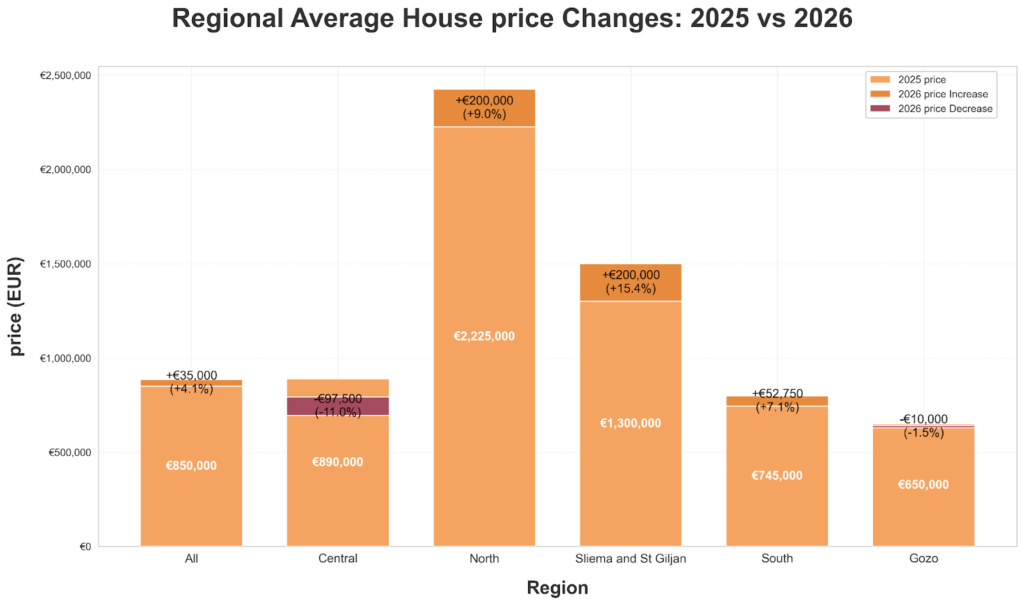
The short version is simple. While apartments rose across every region (6.9%), houses did not. House prices rose 4.1% overall to €885K, but that average hides an 11.0% drop in Central houses and a 15.4% rise in Sliema and St Julian’s.
Malta remains several markets pretending to be one. A large part of that split is demographic rather than architectural. Roughly 30% of Malta’s population is now foreign, and close to one-third of the workforce comes from abroad. That demand is concentrated, mobile and overwhelmingly rental-driven.
Malta apartment prices 2026: growth across all regions despite divergence
The apartment story is the cleaner one. Regional average apartment prices rose from €350K to €374K overall.
- Central: €360K → €372K (+3.3%)
- North: €360K → €383K (+6.2%)
- South: €329K → €340K (+3.4%)
- Sliema & St Julian’s: €675K → €691K (+2.4%)
- Gozo: €260K → €290K (+11.5%)
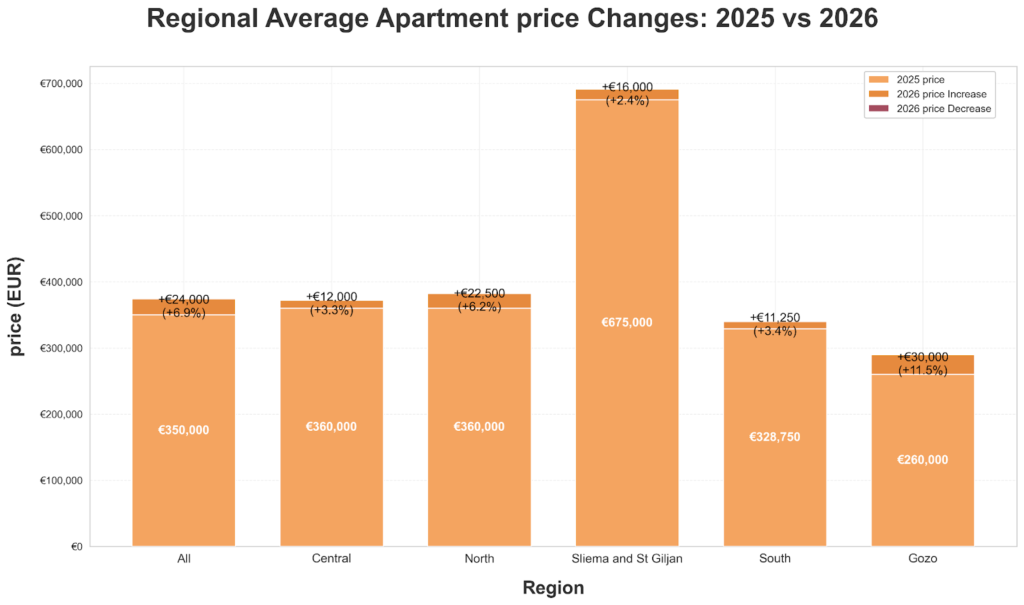
That does not make Gozo the new centre of gravity. It reflects movement from a lower base.
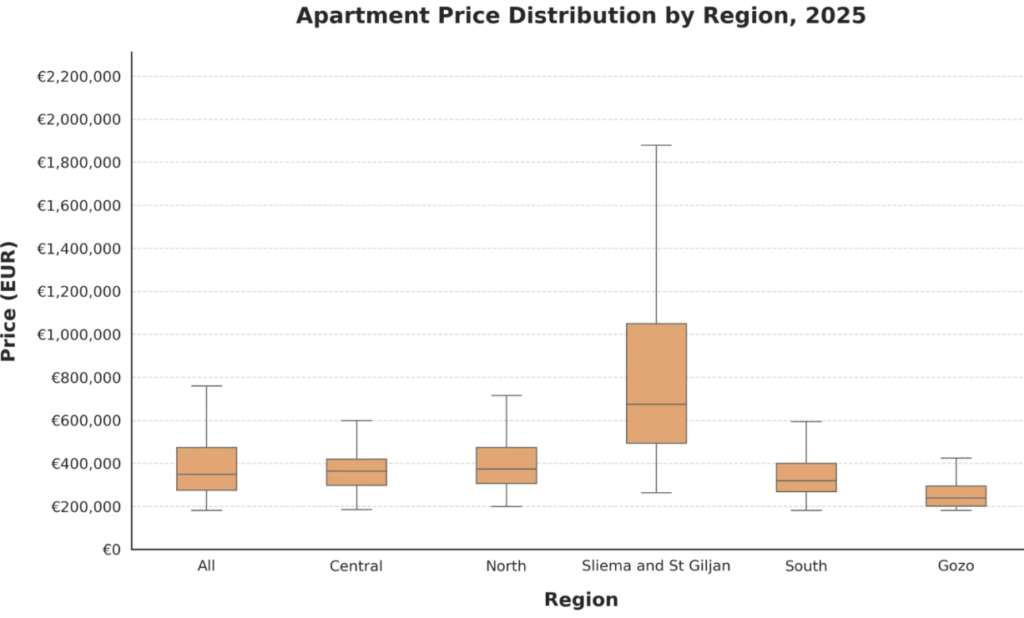
In the raw data:
- Gozo 2-bed median: €255K
- South 3-bed: €404K
- Sliema 1-bed: €615K
- Sliema 3-bed: €933K
Same archipelago. Entirely different chequebooks. Foreign workers, (roughly one-third of the labour force) cluster along Sliema, St Julian’s, Gżira, Msida and St Paul’s Bay. In some areas, foreigners make up 40–60% of residents. That workforce turns over quickly (2–3 years), keeping rental demand high. This is also reflected in the rental market, see our full breakdown of renting in Malta and Gozo.
Malta is not pricing square metres in isolation. It is pricing proximity to jobs, services and an English-speaking urban ecosystem. Supply is still coming through, but in a very Malta sort of way. NSO data shows 2,213 building permits for 12,325 new dwellings approved in 2025, with 72.1% of those dwellings classed as apartments. Much of this is concentrated in the Northern Harbour district, which alone accounted for 577 permits and 3,509 new units.
On paper, that looks like meaningful supply. In practice, it largely feeds the same apartment-heavy, coastal zones already under pressure from a rotating expat workforce. More units are added, but often in the same places, for the same tenants, reinforcing density rather than easing demand.
Malta house prices 2026: Sharp Regional Divergence and Lower Liquidity
Regional average house prices rose from €850K to €885K overall, but with major variation:
- Central: €890K → €793K (–11.0%)
- North: €2.23m → €2.43m (+9.0%)
- Sliema & St Julian’s: €1.3m → €1.5m (+15.4%)
- South: €745K → €798K (+7.1%)
- Gozo: €650K → €640K (–1.5%)
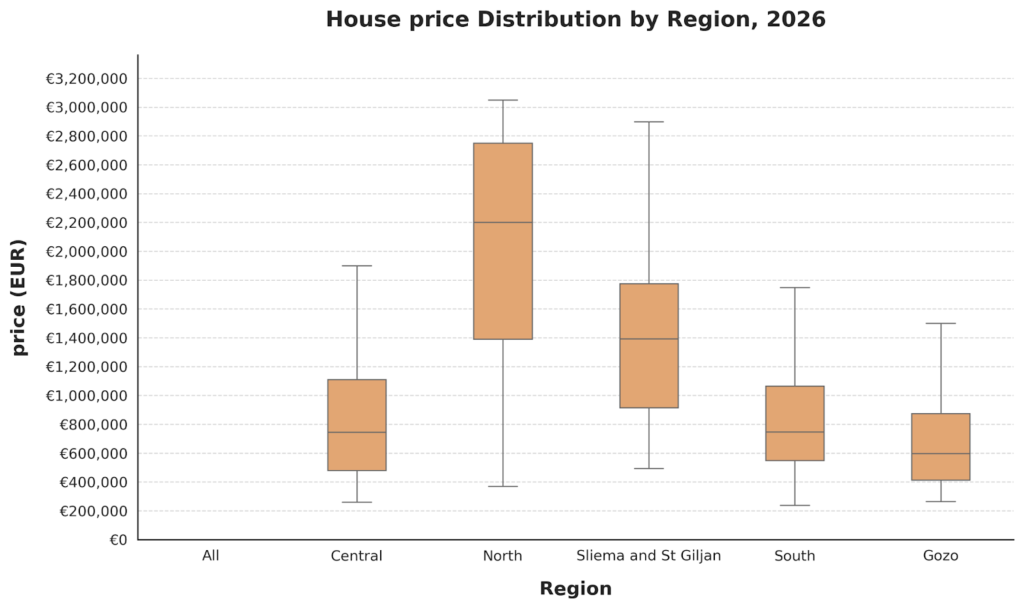
North is the headline. Median prices there reach €2.45m for a 3-bed and €2.86m for a 4-bed. But the dataset is thinner (500 listings). In several segments, one or two listings can move averages significantly. Houses are not driven by the same forces as apartments. The foreign workforce largely rents apartments, not houses. Houses remain a more discretionary, lifestyle-driven market.
2025 vs 2026 Comparison
| Segment | 2025 Trend | 2026 Trend |
| Apartments | Broad growth across regions | Continued growth across all regions |
| Houses | Broad growth with variation | Sharp regional divergence |
| Central Malta | Stable growth | Decline in house prices |
| Coastal Malta | Strong growth | Continued strengthening |
| Market structure | Relatively aligned | Clearly fragmented |
Where to Buy, Rent and Invest in Malta Property in 2026
Buy in: South Malta (€340K average apartments) remains the value entry point.
If you are considering a purchase, see our guide to buying property in Malta as a foreigner.
Rent in: South Malta remains more affordable, with deeper stock and less premium pricing.
Invest in: Apartments remain the more straightforward investment case in Malta, offering stronger liquidity and more consistent exit options compared to houses. This is largely driven by structural rental demand, underpinned by Malta’s sizeable and mobile foreign workforce, which sustains occupancy levels and supports pricing across key urban areas.
For a deeper yield breakdown, see Malta rental prices 2025: apartments vs houses
Supply reinforces that bias, but not in a way that resolves it. Much of the new stock is apartment-led and concentrated in the same urban corridor that attracts Malta’s foreign workforce. With a high-churn tenant base—often staying two to three years—new supply is absorbed quickly, keeping rental pressure and price support firmly in place.
Methodology: analysing 4,471 Malta property listings
This is listing-based research, not transaction data. It reflects seller expectations, not final negotiated prices. The dataset is strongest for apartments and weaker for houses. Apartment conclusions are robust. House conclusions are directional.
Malta is still small. Its property market is not. It behaves less like one system and more like overlapping ones, one of which is effectively an expat housing corridor along the coast. And while supply continues to come through, it is not evenly distributed, adding volume without flattening the structural differences that define the market.
FAQs: Malta property prices, buying and renting in 2026
- Are Malta property prices still rising?
Yes, but unevenly. Apartments rise broadly. Houses diverge. - Why are apartments outperforming houses?
Stronger rental demand, higher liquidity, and expat-driven occupancy. - Where are prices highest?
Sliema and St Julian’s remain the most expensive areas. - Is South Malta good value?
Yes, with lower entry prices and growing interest. - Why is rental demand so strong?
Malta’s foreign workforce and high turnover sustain occupancy. - Is Gozo a good investment?
Lower prices, but weaker rental yields and slower growth.
For a broader perspective on how the market reached this point, revisit our analysis of Malta property prices from 2020 to 2025, which provides a useful baseline for understanding today’s growing divergence.
Thinking About Property in Malta?
For ongoing updates on property trends, tax insights, and expat life in Malta, follow Expatax Malta on social media.
Sources
Expatax Malta Property Report (2020–2025)
National Statistics Office (NSO Malta)





 English
  Danish
  French
  German