


Malta is a popular destination for expatriate families, and it is not uncommon for foreign nationals to welcome a child while legally residing on the island. While the medical process is usually seamless, parents must also complete a number of administrative and immigration-related steps to ensure their child’s status is properly regularised.
Step 1: Birth registration in Malta
A child born in Malta or Gozo must be officially registered with the Public Registry. This is a legal obligation and must be completed within fifteen days from the date of birth.
In most cases, the hospital facilitates the initial notification. However, parents remain responsible for ensuring that the registration is finalised. Once registered, an official Act of Birth is issued, which forms the basis for all future documentation.
Failure to register the birth within the required timeframe may result in delays or administrative complications, particularly when applying for foreign passports or residence documentation.
💡 Important note:
Where the parents are legally married, only one parent is generally required to attend the birth registration.
However, where the parents are in a civil union, both parents are required to be present, and a notarised confirmation may be requested as part of the registration process.
Step 2: Obtaining the Maltese birth certificate
After the birth has been registered, parents may apply for the child’s birth certificate. This document confirms the place of birth but does not grant Maltese nationality.
The birth certificate is a key document and will be required for:
- future administrative or legal procedures
- passport applications with the relevant embassy or consulate
- residence permit or registration applications in Malta
Parents should also consider whether an apostilled or legalised version of the birth certificate is required, depending on the child’s nationality and the requirements of the issuing country.
Step 3: Applying for the child’s passport
A child born in Malta does not automatically acquire Maltese citizenship. In most cases, the child acquires the nationality of one or both parents, and a passport must be obtained from the relevant country of origin.
There is no universal Maltese law imposing a strict deadline such as “two years from birth” to obtain a foreign passport. Passport issuance is governed by the laws and procedures of the child’s country of nationality.
That said, parents should apply for the passport as early as possible. In practice, the passport is required to:
- regularise the child’s immigration status in Malta
- submit residency or family member applications
- travel in and out of Malta lawfully
Delays in obtaining a passport often lead to complications later, especially when residence documentation is time-sensitive.
Step 4: Regularising the child’s residence status in Malta
Once the child has a passport, the next step is to regularise their stay in Malta. The applicable procedure depends on whether the family is residing in Malta under EU free movement rules or a non-EU residence framework.
EU families exercising free movement rights
If at least one parent is an EU, EEA or Swiss national exercising treaty rights in Malta through employment, self-employment, study or self-sufficiency, the child is considered a family member under EU free movement legislation.
EU residence rules require individuals who intend to reside in Malta for more than three months to register their presence. While a newborn is already physically present in Malta from birth, the practical approach is to complete birth registration and obtain the passport first, and then submit the relevant residence documentation for the child as a family member of the EU national.
The three-month period is particularly important once the child holds a valid passport, as this is the point at which formal registration becomes necessary for longer-term residence.
Newborns in Non-EU Resident Families
For non-EU families, a child born in Malta does not automatically obtain residence rights. The newborn must be formally regularised under the parent’s existing residence framework.
In practice, the process involves three steps:
- register the birth and obtain the Maltese birth certificate
- secure a valid passport or temporary travel document from the child’s country of nationality
- submit the appropriate application under the Family Members Policy once the child holds a passport
If no embassy is available in Malta, parents may need to obtain a temporary travel document through their consular authorities, travel to the home country to issue the passport, and then return to Malta. After re-entry, the family member application can be submitted, as the policy recognises minor children born in Malta.
In more detail, the policy provides that applications should normally be submitted before the family member is physically present in Malta. However, it expressly recognises an exception for minor children born in Malta, allowing their residence to be regularised even though they are already on the territory at birth.
💡
Although the child is born in Malta, their residence status remains dependent on the sponsoring parent, and the residence permit must be renewed in line with the applicable validity period: non-eu expat children residence cards are issued on 1 year term – therefore are to be renewed yearly, even if the parents have residence cards on longer terms – such as 2 year signle work permit or long term residence.
Embassies and Consulates in Malta
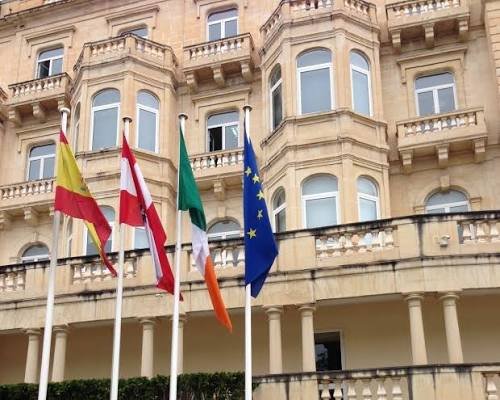
If you need to arrange a passport or emergency travel document for your newborn, you should first check whether your country has an embassy or consulate in Malta.
A publicly available list of foreign diplomatic missions accredited to Malta
If your country is not represented locally, the nearest accredited mission abroad will usually handle the application.
After the passport or travel document is issued, the appropriate EU or non-EU residence or dependency procedure should be completed.
A Clear Path Forward
Welcoming a child while living abroad is a major life moment, and ensuring the legal formalities are handled correctly provides long-term stability for your family in Malta. The procedures for newborns are structured and predictable when approached in the right sequence, but they require awareness of both civil registration and immigration requirements.
For personalised support with newborn residency matters and broader family compliance in Malta, our team is available to guide you at every stage.
Stay connected with us on social media for ongoing insights into expat life in Malta, including tax, property and residency updates.




 English
  Danish
  French
  German