



Engagement and termination reporting are fundamental employer obligations in Malta. Employment does not officially begin or end with a contract alone. It must also be formally notified to Jobsplus.
Under the Employment and Training Services Act (Chapter 594 of the Laws of Malta), employers are legally required to notify Jobsplus whenever an employee starts work and whenever that employment is terminated. These notifications form part of Malta’s national employment record system and are a core element of employer compliance.
While the legal framework has been in place for years, enforcement expectations are sharper in 2026. Reporting deadlines are being monitored more closely, and compliance is increasingly linked to broader workforce regulation, particularly where third country national employment is concerned.
The Four Working Day Rule Explained
Employers are required to submit the Engagement Form:
- On the employee’s first day of work
- No later than four working days from the effective start date
The same four working day deadline applies when employment ends and a Termination Form must be filed.
In practical terms, submission on Day 1 is the safest approach. The four working day period is a legal maximum, not an administrative grace period.
Engagement and termination forms must be submitted through the Jobsplus Employer Online Services portal, which is the standard reporting channel for employers. Internal processes should therefore ensure that portal access is active before the employee’s start date.
There are limited exceptions. Certain self-employed registrations and household employer cases may be submitted by email rather than through the online system.
Where email submission is required, the forms should be sent to:
- Malta: hriu.jobsplus@gov.mt
- Gozo: hriuforms.jobsplus@gov.mt
Employers should retain proof of submission and any acknowledgement received. Clear documentation is part of good compliance management.
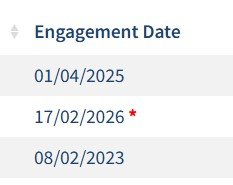
It is also important to understand that late submissions are visibly flagged within the Jobsplus Employer Online Services portal. Forms submitted outside the statutory time frame are marked with an star indicator, making delays identifiable within the system. This reinforces the importance of meeting the deadline consistently.
A Quick Note on Single Permit Holders
For third country nationals holding a Single Work Permit, the engagement and termination requirement still applies in full.
Employment may only commence once the Temporary Authorisation to Work, the blue paper, has been issued. The issue date of that authorisation effectively allows the employee to start working for the approved employer.
However, the permit itself does not replace the employer’s obligation to notify Jobsplus. Once the employee physically starts work, the Engagement Form must be submitted on that first working day and no later than four working days from the effective start date.
The same principle applies when employment ends. Employers are legally required to submit the Termination Form within four working days from the effective termination date. This obligation is not discretionary. An employer cannot delay, withhold, or refuse termination reporting due to internal disputes, pending payments, or other disagreements with the employee.
Common Areas Where Employers Fall Behind
Employers most often struggle with engagement reporting due to:
- Unclear internal responsibility for submissions
- Portal access not active on the start date
- Onboarding occurring outside normal business hours
- Misunderstanding of deadlines
A practical compliance rule is simple: confirm the start date, prepare all employee information in advance, and submit the engagement and termination forms on Day 1 whenever possible.
Why Enforcement Is Stronger in 2026
Recent communications from Jobsplus and advisory sources confirm that compliance with statutory timeframes is being reinforced. Reporting deadlines are no longer treated as loosely as in the past, and delays can attract administrative consequences.
For employers hiring third country nationals, timely reporting is even more critical. Delays in engagement or termination reporting may impact the processing of employment licences and Single Permits, potentially disrupting recruitment and operations.
For ongoing insights on employment, tax, and regulatory developments in Malta, stay connected and follow us across our social media channels for practical updates that matter to your business.





 English
  Danish
  French
  German