


Anyone living in Malta will have noticed how much conversations around the cost of living have changed over the past few years. Grocery bills, rent, eating out and everyday services have all become more expensive, but the latest figures suggest that the pace of those increases is beginning to ease.
According to the latest available data from Malta’s Nationales Statistikamt (NSO), annual inflation measured by the Harmonised Index of Consumer Prices (HICP) stood at 2.0% in June 2026, compared with 2.5% in June 2025.
On the surface, that is good news. Inflation is cooling. But does that mean Malta is becoming cheaper to live in?
Not quite.
Inflation in Malta 2025 vs 2026
The first six months of 2025 and 2026 show two noticeably different trends.
| Monat | 2025 | 2026 |
|---|---|---|
| Januar | 1.8% | 2.3% |
| Februar | 2.0% | 2.3% |
| März | 2.2% | 2.3% |
| April | 2.6% | 2.5% |
| May | 2.7% | 2.1% |
| Juni | 2.5% | 2.0% |
During 2025, inflation gathered momentum as the year progressed. It rose from 1.8% in January to 2.7% in May before easing slightly to 2.5% in June.The picture in 2026 has been different.
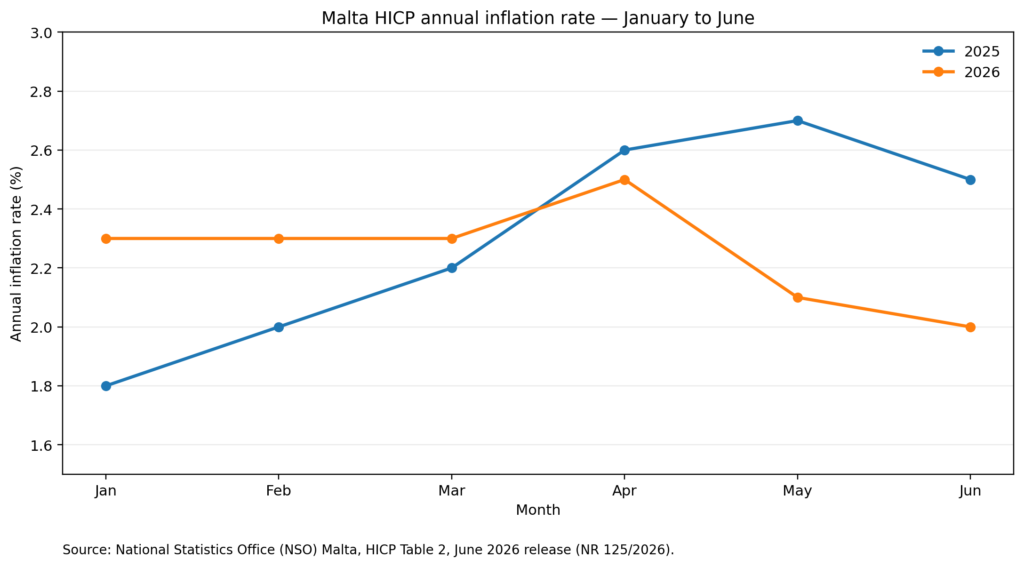
Inflation remained at 2.3% for the first three months of the year, briefly increased to 2.5% in April, and then fell to 2.1% in May and 2.0% in June.
So, when comparing June with June, Malta’s inflation rate has fallen by half a percentage point in the space of a year. That does not sound dramatic, but the direction is important. Price growth is clearly becoming more moderate.
But are prices actually falling?
This is where inflation figures are often misunderstood. Lower inflation does not mean lower prices.
If something costs €100 and increases by 2.5%, it becomes €102.50. If inflation subsequently falls to 2%, the price does not return to €100. It simply continues increasing at a slower rate. This is essentially what Malta is experiencing.
The sharp price increases of previous years have not generally been reversed. Instead, the speed at which prices are increasing has slowed. For households, that distinction matters much more than the headline inflation number itself.
The headline figure does not tell the whole story
Malta actually has two important measures of consumer inflation. The Harmonised Index of Consumer Prices (HICP) is particularly useful for comparing Malta with other EU countries. The Retail Price Index (RPI) is more closely associated with expenditure by Maltese private households and plays an important role in Malta’s cost-of-living adjustment system.
And in June 2026, the two indicators were telling slightly different stories. Annual HICP inflation stood at 2.0%, while annual RPI inflation was higher at 2.5%. The RPI’s 12-month moving average stood at 2.6%.
For someone actually paying rent, buying groceries and using services in Malta, looking beyond the headline HICP rate therefore gives a more complete picture of what is happening to household costs.
Housing is still getting considerably more expensive
Perhaps the most striking figure in the latest NSO data relates to housing. In June 2026, the RPI Housing Index increased by 6.5% year on year. Within the category, NSO recorded increases of:
- 3.6% in rents
- 7.5% in materials for house maintenance
- 6.4% in house maintenance services
Housing alone contributed around 0.51 percentage points to annual RPI inflation. That matters particularly for Malta’s international community.
New residents and expats are often more exposed to the rental market than established households that already own their homes. As a result, someone’s personal experience of inflation can look very different from Malta’s national 2.0% HICP figure.
If a large proportion of your monthly income goes towards accommodation, a 6.5% increase in the housing category is likely to feel much more significant than a headline inflation rate of 2%.
Food is still putting pressure on household budgets
Food remains another important part of the picture. In June 2026, food and non-alcoholic beverages contributed around 0.31 percentage points to HICP inflation, with NSO identifying higher meat prices among the factors behind the increase.
Under the RPI, food contributed approximately 0.44 percentage points to annual inflation. The extreme food-price increases seen earlier in the decade may have moderated, but grocery shopping and eating out continue to put pressure on household budgets.
Eating out and accommodation remain inflation drivers
One particularly interesting feature of Malta’s inflation data is the role of restaurants and accommodation. In June 2026, restaurants and accommodation services made the largest positive contribution to HICP inflation, adding approximately 0.44 percentage points.
NSO attributed much of this increase to restaurant prices. For Malta, this is significant. Tourism remains a major part of the economy, while residents also spend heavily across restaurants, cafés, hotels and other hospitality services.
The Central Bank of Malta has similarly highlighted services as an area where inflation can remain persistent, supported by domestic demand, tourism and wage developments. So while goods inflation may be becoming more manageable, the cost of services is still worth watching.
There is some good news for consumers
Not everything became more expensive. NSO recorded annual price declines in several areas during June 2026.
Clothing and footwear prices were down 3.9%, while information and communication prices fell 1.6%. These decreases helped pull Malta’s overall inflation rate lower.
This illustrates why personal inflation can vary so much between households. Someone spending heavily on rent, food and restaurants may feel that their cost of living is rising considerably faster than someone whose spending is concentrated in categories where prices are stable or falling.
Malta’s energy prices remain an important part of the story
Malta is also somewhat unusual when it comes to energy. Government support has continued to limit the impact of international electricity and fuel price movements on Maltese households.
In June 2026, the RPI category covering water, electricity, gas and fuels recorded annual inflation of 0.0%.
This has provided Malta with an important degree of protection from energy-price volatility and has helped contain the overall inflation rate. It is also one reason why Malta’s inflation experience can differ from that of other European countries.
What happens to inflation during the rest of 2026?
There is one important caveat when discussing “2026 inflation”. The year is not over.
The 2.0% figure is the annual inflation rate recorded in June 2026, not Malta’s final inflation rate for the whole year. The latest forecast from the Central Bank of Malta, published in June 2026, expects HICP inflation to average 2.5% for the full year.
Interestingly, the Bank had previously expected inflation of 2.3%, but revised its forecast upwards amid increased international uncertainty and the possibility of higher imported food and goods prices.
The Central Bank currently expects inflation of 2.5% in 2027 before moderating to 2.2% in 2028. So while the latest NSO figures are encouraging, it is still too early to say exactly where Malta’s 2026 inflation rate will eventually settle.
So, is Malta getting more expensive?
Yes, but more slowly.
That is probably the simplest way to describe what the latest figures are telling us. Malta’s headline HICP inflation rate has fallen from 2.5% in June 2025 to 2.0% in June 2026. The country has also moved from having inflation above the euro-area rate to below it.
Those are positive developments. But they do not mean the cost-of-living issue has disappeared.
Housing costs are still rising considerably faster than headline inflation. Food remains an important contributor. Restaurant and accommodation prices continue to increase, while the government’s intervention in energy prices is helping to keep another major household expense relatively stable. For expats in particular, the national average may not reflect their own experience.
Someone renting a property, eating out regularly and paying for services may face a noticeably different increase in living costs from a household that owns its home and has different spending habits.
The better question, therefore, may not be simply “What is Malta’s inflation rate?”
It is: “Which prices are increasing, and how much do those expenses matter to your household?”



 English
  Danish
  French
  German