


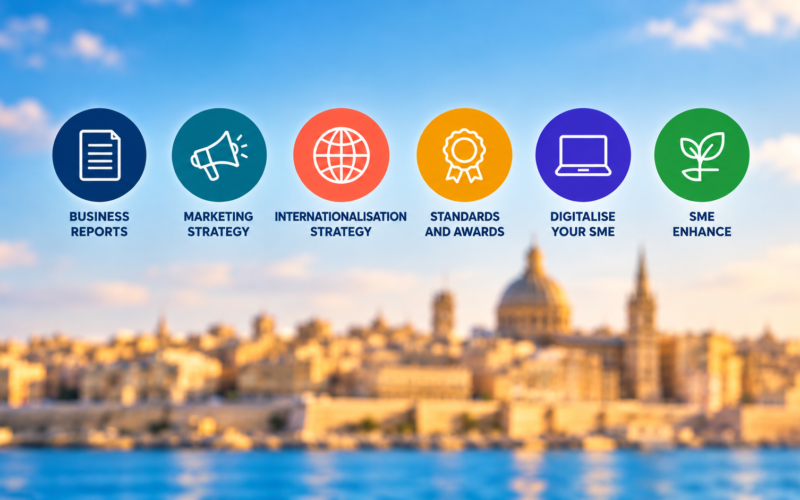
The current round of EU-backed SME grants in Malta is not pausing. It is ending. Six schemes co-financed under the European Regional Development Fund (ERDF) 2021-2027 programme are running their final cut-off dates between now and 14 December 2026. Once those deadlines pass, the schemes close. The grants range from a fixed €4,000 lump sum to a combined maximum of €235,400, covering digital investment, productive equipment, business analysis, marketing strategy, internationalisation planning, and quality standards.
Why This Closure Matters
Malta’s current SME grant landscape is almost entirely funded through the ERDF 2021-2027 cohesion programme. The six schemes in this article were introduced in early 2025 as a consolidation of earlier incentives, with budgets drawn from that envelope. When the cut-off calendar closes, those budgets close with it.
All six schemes share the same remaining application cut-off dates:
- 16 October 2026
- 30 October 2026
- 13 November 2026
- 30 November 2026
- 14 December 2026
Applications are assessed after each cut-off date and funding is awarded on merit, subject to budget availability. Early submission is recommended, as it reduces the risk of available funds being exhausted before an application is processed.
Schemes with a 30 November 2026 Cut-Off
Digitalise Your SME (Call 2)
The largest of the six schemes, with a €15 million budget. It funds software, hardware, cloud subscriptions, cybersecurity, IoT, and analytical tools that improve internal operations. E-commerce and marketing websites, mobile phones, cabling, and maintenance contracts are excluded.
The minimum grant is €25,000 and the maximum base grant is €128,400. A separate AI top-up of up to €100,000 brings the combined ceiling to approximately €235,400 for projects including AI-powered solutions or intelligent automation. Aid intensity is 50% in Malta and 60% in Gozo under the de minimis route, with higher rates available under GBER for start-ups or businesses that have exhausted their de minimis headroom.
Before applying, every business must complete a MDIA Digital Intensity Assessment, a mandatory step that typically takes one to two weeks. Applications above €60,000 also require a financial viability check. Businesses with negative net assets are ineligible, with a limited exception for qualifying start-ups.
SME Enhance
SME Enhance funds productive investment in equipment, plant, and machinery for business expansion, modernisation, or diversification. The scheme has a €6 million budget.
The investment must be led by equipment or machinery. Ancillary items are capped at the lower of 10% of equipment costs or €10,000. Lease costs for operational premises can be included up to 10% of equipment costs (20% for start-ups) over a two-year period. Assets must remain operational for at least three years after the final grant payment.
The minimum grant is €10,000 and the maximum is €128,400. Aid intensity is 50% in Malta and 60% in Gozo under de minimis. GBER rates are available for businesses that have exhausted their de minimis headroom, though at lower percentages. Applications above €60,000 trigger a financial viability check. Projects must be completed within 24 months, with extensions available at a 1% grant reduction per additional six-month block.
Business Reports for SMEs
A fixed grant of €4,000, representing an 80% rebate on the cost of an externally commissioned report. Two report types qualify: a Process and Systems Review and a Business Plan for investment or bank financing. The grant is paid by reimbursement after the report is delivered.
Three conditions commonly catch businesses out:
- Pre-approval is mandatory. The report cannot be commissioned before the grant is approved. Any costs incurred beforehand are ineligible.
- The consultant must be registered with the Measures and Support Division and independent of the applicant.
- No outstanding liabilities. The business must have no tax or national insurance arrears above €1,000 per type at the application date.
A well-executed Business Plan report can also serve as a foundation for a subsequent investment grant application.
Schemes with a 14 December 2026 Cut-Off
Marketing Strategy for Micro and Small Enterprises
Up to €10,000 toward the cost of commissioning a marketing strategy from an external, registered provider. Restricted to micro and small enterprises. The deliverable must cover market analysis, positioning and branding, measurement and evaluation, and an implementation plan. Advertising spend, marketing materials, and promotional execution are not covered.
Aid intensity is 60% for micro enterprises and start-ups within five years of registration, and 50% for those more than five years old. Activities must be completed within six months, and each undertaking may submit only one application.
Internationalisation Strategy for SMEs
Open to micro, small, and medium-sized enterprises. Offers up to €20,000 across two components: Part 1 covers scoping of market opportunities abroad (capped at €10,000), and Part 2 covers a country-specific strategy for identified markets. The two parts can be applied for together or separately, and each undertaking may submit up to two applications.
Aid intensity is 60% for micro and small start-ups within five years, and 50% for all others including medium enterprises. Projects run for six or twelve months, as chosen at application.
Standards and Awards for SMEs
This scheme funds the advisory services required to achieve recognised quality, governance, sustainability, or operational standards. What is funded is the consulting engagement that leads to the standard, not the certification or registration fee itself. Regulatory certifications required for market placement, such as CE marking or food safety compliance, are excluded. The scheme is designed for voluntary standards such as ISO 9001, ISO 14001, or sustainability and governance frameworks.
The maximum grant is €15,000 for a single standard, rising to €20,000 where the applicant pursues more than two standards through the same provider in one application. Aid intensity is 60% for micro enterprises and start-ups within five years, and 50% for all others. The business must have been operating for at least one year at the application date. Each undertaking may submit up to two applications, and activities must be completed within six months.
Practical Issues Every Applicant Needs to Address
Check Your De Minimis Headroom First
All six schemes use de minimis aid as either the primary or default route, meaning each grant counts toward the €300,000 rolling three-year ceiling across all public sources, including Malta Enterprise, Malta Tourism Authority, and government wage supplements.
Businesses that received COVID-related wage supplements or emergency grants in 2023 and 2024 may have used significant headroom without realising it. Calculate total public aid received in the rolling three-year window before applying. If headroom is limited, the GBER routes under SME Enhance and Digitalise Your SME provide an alternative, but at lower aid intensity. Applicants must self-declare cumulative aid received on the application form, and an inaccurate declaration creates a repayment risk.
Financial Viability and the €60,000 Trigger
Both investment schemes require a financial viability check for applications above €60,000. Businesses with negative net assets are ineligible, and the project’s eligible costs must exceed 2% of net assets. Malta Enterprise provides a self-assessment tool via fondi.eu. Run this check early, before investing time in a full application.
Common Reasons Applications Fail
- Using an unregistered consultant on any of the advisory schemes is a disqualifying error that cannot be corrected after submission.
- Incurring costs before the grant agreement is signed, including signing contracts or paying deposits, disqualifies any investment that has already started.
- Scoring below 50% of the selection criteria makes an application ineligible even if it is otherwise complete.
- Even a technically eligible application can be unsuccessful if the scheme budget is exhausted before it is processed.
Pay only what you owe
Need help understanding the Malta tax system? From Malta tax returns and expat tax advice to corporate compliance and business accounting services in Malta, we help individuals and companies stay compliant and tax-efficient.
Get tax advice →Before You Apply
The MDIA Digital Intensity Assessment for Digitalise Your SME typically takes one to two weeks and must be completed before submission. Do not leave it to the days before the December deadline. For advisory schemes, the service provider must be identified, confirmed as registered and independent, and a formal quotation obtained before submission.
Businesses in Gozo should confirm their eligibility for the higher aid intensity at the outset. On a €120,000 eligible investment, the difference between 50% and 60% is €12,000.
Acting Before the Window Closes
With five application deadlines remaining until 14 December 2026, businesses still have time to take advantage of these funding opportunities. Some schemes are easier to apply for, while others require additional checks, quotations, and supporting documents. The key is to choose the right scheme and start preparing early. With funding limited, acting sooner could make all the difference.




 English
  Danish
  French
  German